I am a PhD candidate in Data Science at the Technion, working under the supervision of Yevgeni Berzak at the Language, Computation and Cognition (LaCC) Lab.
My research aims to decode our cognitive state in language processing, with a focus on utilizing eye movements in reading and neural activity while listening.
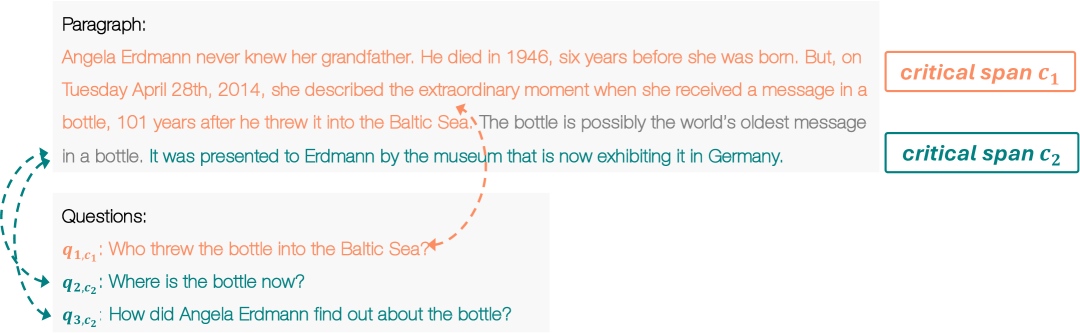
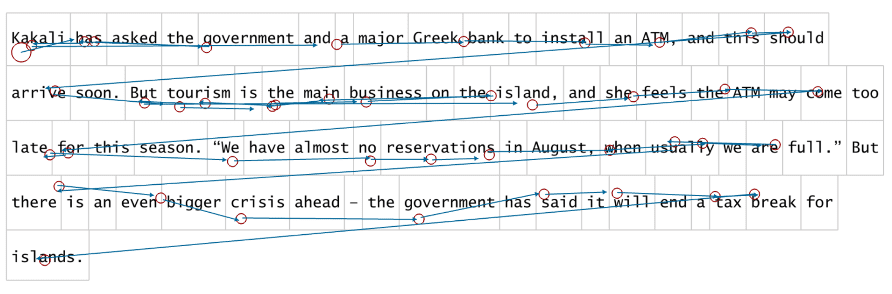
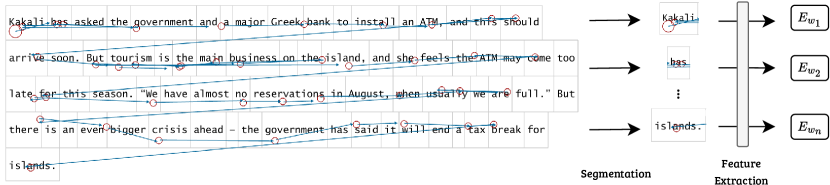
When reading, we often have specific information that interests us in a text. More broadly, in daily life, people approach texts with any number of text-specific goals that guide their reading behavior. In this work, we ask, for the first time, whether open-ended reading goals can be automatically decoded solely from eye movements in reading. To address this question, we introduce goal decoding tasks and evaluation frameworks using large-scale eye tracking for reading data in English with hundreds of text-specific information seeking tasks. We develop and compare several discriminative and generative multimodal text and eye movements LLMs for these tasks. Our experiments show considerable success on the task of selecting the correct goal among several options, and even progress towards free-form textual reconstruction of the precise goal formulation. These results open the door for further scientific investigation of goal driven reading, as well as the development of educational and assistive technologies that will rely on real-time decoding of reader goals from their eye movements.
@inproceedings{hadar2026goals,
  title={Decoding Open-Ended Information Seeking Goals from Eye Movements in Reading},
  author={Hadar, Cfir Avraham and Shubi, Omer and Meiri, Yoav and Heshes, Amit and Berzak, Yevgeni},
  booktitle={Proceedings of the Fourteenth International Conference on Learning Representations},
  year={2026}
}
Automatic methods for scoring text readability have been studied for over a century, and are widely used in research and in user-facing applications in many domains. Thus far, the development and evaluation of such methods have primarily relied on two types of offline human behavioral data, performance on reading comprehension tests and ratings of text readability levels. In this work, we instead focus on a fundamental and understudied aspect of readability, real-time reading ease, captured with online reading measures using eye tracking. We introduce a new cognitive evaluation framework for readability scoring methods that quantifies their ability to account for reading ease, while controlling for content variation across texts. Applying this evaluation to prominent traditional readability formulas, NLP-based methods, commercial systems used in education, and frontier LLMs suggests that they are all poor predictors of English reading ease in adults as compared to word properties commonly used in psycholinguistics for the prediction of reading times. This outcome holds across L1 and L2 speakers, different reading regimes, and textual units of different lengths. Our results reveal an important limitation of a wide range of methods for readability scoring, highlight the utility of real-time behavioral benchmarks for readability research, and call for new, cognitively driven readability scoring approaches that can better account for how humans experience texts in real time.
@article{gruteke2026ara,
  title={Eye Tracking Based Cognitive Evaluation of Automatic Readability Assessment Methods},
  author={Gruteke Klein, Keren and Frenkel, Shachar and Shubi, Omer and Berzak, Yevgeni},
  journal={Computational Linguistics},
  pages={1--29},
  year={2026},
  publisher={MIT Press},
  doi={10.1162/coli.a.649}
}
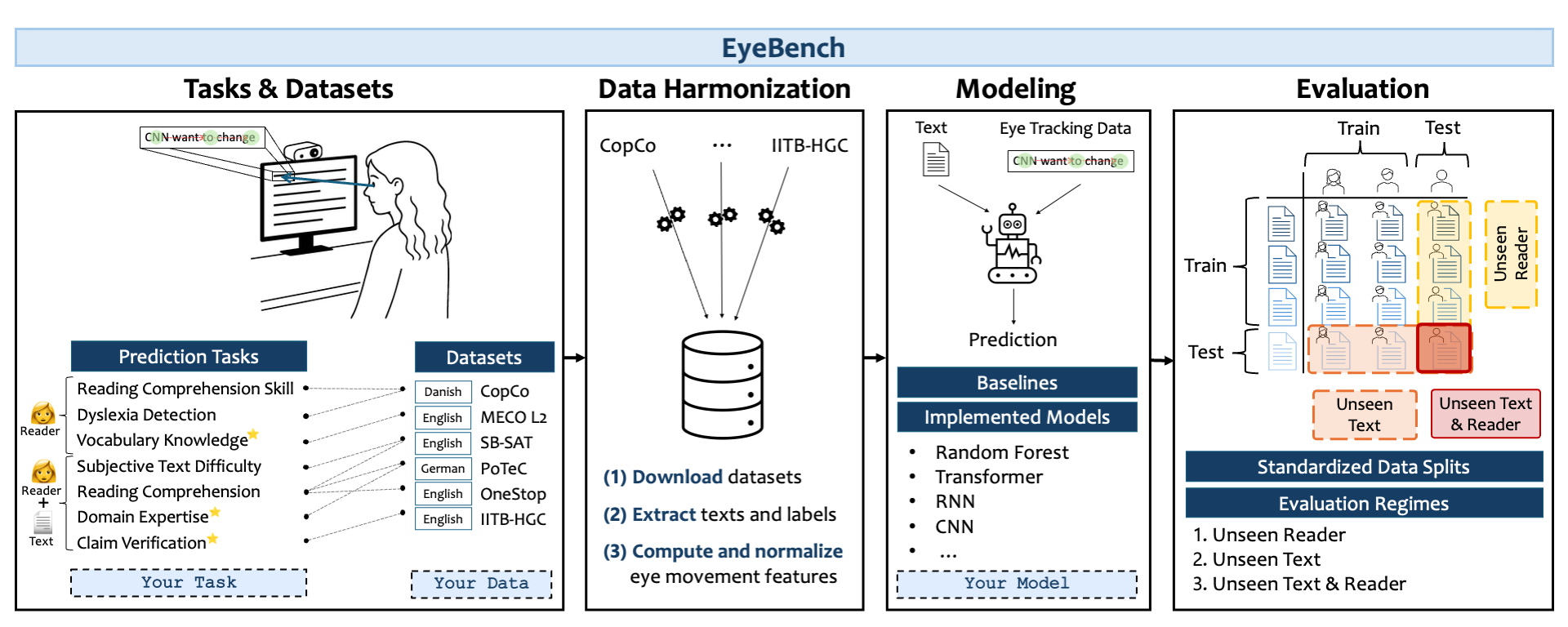
We present EyeBench, the first benchmark designed to evaluate machine learning models that decode cognitive and linguistic information from eye movements during reading. EyeBench offers an accessible entry point to the challenging and underexplored domain of modeling eye tracking data paired with text, aiming to foster innovation at the intersection of multimodal AI and cognitive science. The benchmark provides a standardized evaluation framework for predictive models, covering a diverse set of datasets and tasks, ranging from assessment of reading comprehension to detection of developmental dyslexia. Progress on the EyeBench challenge will pave the way for both practical real-world applications, such as adaptive user interfaces and personalized education, and scientific advances in understanding human language processing.
@inproceedings{shubi2025eyebench,
  title={EyeBench: Predictive Modeling from Eye Movements in Reading},
  author={Shubi, Omer and Reich, David Robert and Gruteke Klein, Keren and Angel, Yuval and Prasse, Paul and J{\"a}ger, Lena Ann and Berzak, Yevgeni},
  booktitle={Proceedings of the Thirty-Ninth Annual Conference on Neural Information Processing Systems},
  year={2025}
}
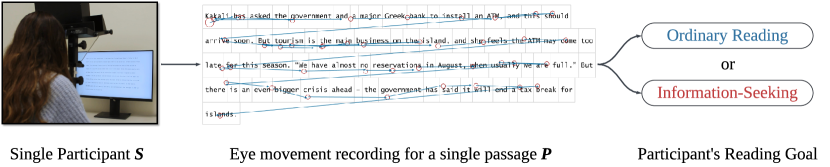
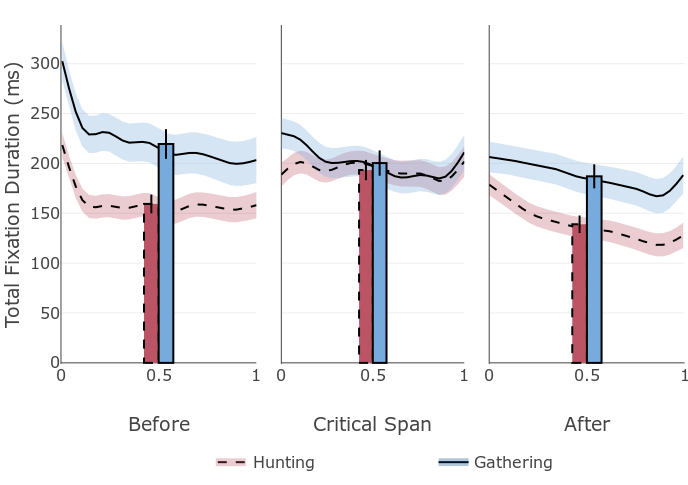
Readers can have different goals with respect to the text they are reading. Can these goals be decoded from the pattern of their eye movements over the text? In this work, we examine for the first time whether it is possible to decode two types of reading goals that are common in daily life: information seeking and ordinary reading. Using large scale eye-tracking data, we apply to this task a wide range of state-of-the-art models for eye movements and text that cover different architectural and data representation strategies, and further introduce a new model ensemble. We systematically evaluate these models at three levels of generalization: new textual item, new participant, and the combination of both. We find that eye movements contain highly valuable signals for this task. We further perform an error analysis which builds on prior empirical findings on differences between ordinary reading and information seeking and leverages rich textual annotations. This analysis reveals key properties of textual items and participant eye movements that contribute to the difficulty of the task.
@inproceedings{shubi2025goals,
  title={Decoding Reading Goals from Eye Movements},
  author={Shubi, Omer and Hadar, Cfir Avraham and Berzak, Yevgeni},
  booktitle={Proceedings of the 63rd Annual Meeting of the Association for Computational Linguistics},
  year={2025}
}
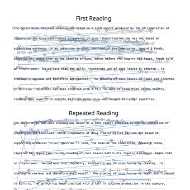
Be it your favorite novel, a newswire article, a cooking recipe or an academic paper -- in many daily situations we read the same text more than once. In this work, we ask whether it is possible to automatically determine whether the reader has previously encountered a text based on their eye movement patterns. We introduce two variants of this task and address them with considerable success using both feature-based and neural models. We further introduce a general strategy for enhancing these models with machine generated simulations of eye movements from a cognitive model. Finally, we present an analysis of model performance which on the one hand yields insights on the information used by the models, and on the other hand leverages predictive modeling as an analytic tool for better characterization of the role of memory in repeated reading.
@inproceedings{meiri2025dejavu,
  title={D{\'e}j{\`a} Vu? Decoding Repeated Reading from Eye Movements},
  author={Meiri, Yoav and Shubi, Omer and Hadar, Cfir Avraham and Kreisberg Nitzav, Ariel and Berzak, Yevgeni},
  booktitle={Proceedings of the 63rd Annual Meeting of the Association for Computational Linguistics},
  year={2025}
}
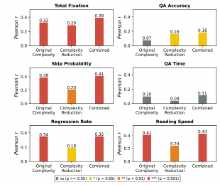
Text simplification is a common practice for making texts easier to read and easier to understand. To which extent does it achieve these goals, and which participant and text characteristics drive simplification benefits? In this work, we use eye tracking to address these questions for the first time for the population of adult native (L1) English speakers. We find that 42% of the readers exhibit reading facilitation effects, while only 2% improve reading comprehension accuracy. We further observe that reading fluency benefits are larger for slower and less experienced readers, while comprehension benefits are more substantial in lower comprehension readers, but not vice versa. Finally, we find that high-complexity original texts are key for enhancing reading fluency, while large complexity reduction is more pertinent to improving comprehension.
@inproceedings{gruteke2025effect,
  title={The Effect of Text Simplification on Reading Fluency and Reading Comprehension in L1 English Speakers},
  author={Gruteke Klein, Keren and Shubi, Omer and Frenkel, Shachar and Berzak, Yevgeni},
  booktitle={Proceedings of the Annual Meeting of the Cognitive Science Society},
  volume={47},
  year={2025}
}
We present OneStop Eye Movements, a large-scale corpus of eye movements in reading, in which native (L1) speakers read newswire texts in English and answer reading comprehension questions. OneStop has 152 hours of eye movement recordings from 360 participants for 2.6 million word tokens, more data than all the existing public broad coverage English L1 eye tracking datasets combined. The eye movement data was collected for extensively piloted reading comprehension materials comprising 486 reading comprehension questions and auxiliary text annotations geared towards behavioral analyses of reading comprehension. Importantly, OneStop includes multiple reading regimes: ordinary reading, information seeking, repeated reading of the same text, and reading simplified text.
@article{berzak2025onestop,
  title={OneStop: A 360-Participant English Eye Tracking Dataset with Different Reading Regimes},
  author={Berzak, Yevgeni and Malmaud, Jonathan and Shubi, Omer and Meiri, Yoav and Lion, Ella and Levy, Roger},
  journal={Nature Scientific Data},
  year={2025}
}
@article{holodovsky2025imagers,
  title={Imagers for Spaceborne Cloud Tomography},
  author={Holodovsky, Vadim and Tzabari, Masada and Shubi, Omer and Eytan, Eshkol and Koren, Ilan and Altaratz, Orit and Schilling, Klaus and Schechner, Yoav Y.},
  journal={IEEE Transactions on Geoscience and Remote Sensing},
  year={2025}
}
Can human reading comprehension be assessed from eye movements in reading? In this work, we address this longstanding question using large-scale eyetracking data. We focus on a cardinal and largely unaddressed variant of this question: predicting reading comprehension of a single participant for a single question from their eye movements over a single paragraph. We tackle this task using a battery of recent models from the literature, and three new multimodal language models. We evaluate the models in two different reading regimes: ordinary reading and information seeking, and examine their generalization to new textual items, new participants, and the combination of both. The evaluations suggest that the task is highly challenging, and highlight the importance of benchmarking against a strong text-only baseline.
@inproceedings{shubi-etal-2024-fine,
  title={Fine-Grained Prediction of Reading Comprehension from Eye Movements},
  author={Shubi, Omer and Meiri, Yoav and Hadar, Cfir and Berzak, Yevgeni},
  booktitle={Proceedings of the 2024 Conference on Empirical Methods in Natural Language Processing},
  month={nov},
  year={2024},
  address={Miami, Florida, USA},
  publisher={Association for Computational Linguistics},
  pages={3372--3391}
}
The effect of surprisal on processing difficulty has been a central topic of investigation in psycholinguistics. Here, we use eyetracking data to examine three language processing regimes that are common in daily life but have not been addressed with respect to this question: information seeking, repeated processing, and the combination of the two. Using standard regime-agnostic surprisal estimates we find that the prediction of surprisal theory regarding the presence of a linear effect of surprisal on processing times, extends to these regimes.
@inproceedings{klein-etal-2024-effect,
  title={The Effect of Surprisal on Reading Times in Information Seeking and Repeated Reading},
  author={Klein, Keren and Meiri, Yoav and Shubi, Omer and Berzak, Yevgeni},
  booktitle={Proceedings of the 28th Conference on Computational Natural Language Learning},
  month={nov},
  year={2024},
  address={Miami, FL, USA},
  publisher={Association for Computational Linguistics},
  pages={219--230}
}
@article{goldbraikh2024mstcrnet,
  title={MS-TCRNet: Multi-Stage Temporal Convolutional Recurrent Networks for Action Segmentation Using Sensor-Augmented Kinematics},
  author={Goldbraikh, Adam and Shubi, Omer and Rubin, Or and Pugh, Carla M. and Laufer, Shlomi},
  journal={Pattern Recognition},
  year={2024}
}
In this work, we use question answering as a general framework for studying how eye movements in reading reflect the reader's goals, how they are pursued, and the extent to which they are achieved. We leverage fine-grained annotations of task-critical textual information to perform a detailed comparison of eye movements in information-seeking and ordinary reading regimes. We further examine how eye movements during information seeking relate to question answering behavior. We find that reading times, saccade patterns and sensitivity to the linguistic properties of the text are all strongly and systematically conditioned on the reading task, and further interact with question answering behavior.
@inproceedings{shubi2023,
  title={Eye Movements in Information-Seeking Reading},
  author={Shubi, Omer and Berzak, Yevgeni},
  booktitle={Proceedings of the Annual Meeting of the Cognitive Science Society},
  year={2023}
}
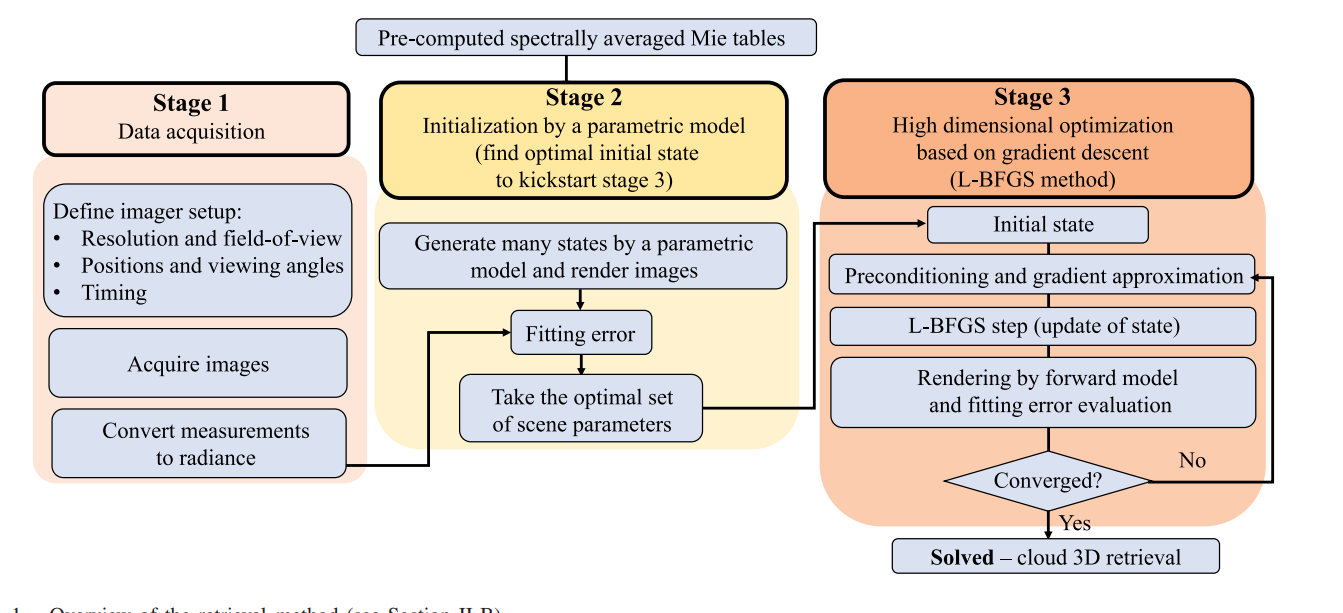
We introduce a comprehensive method for space-borne 3-D volumetric scattering-tomography of cloud microphysics, developed for the CloudCT mission. The retrieved microphysical properties are the liquid-water-content (LWC) and effective droplet radius within a cloud.
@article{tzabari2022settings,
  title={Settings for Spaceborne 3-D Scattering Tomography of Liquid-Phase Clouds by the CloudCT Mission},
  author={Tzabari, Masada and Holodovsky, Vadim and Shubi, Omer and Eytan, Eshkol and Koren, Ilan and Schechner, Yoav Y.},
  journal={IEEE Transactions on Geoscience and Remote Sensing},
  year={2022},
  doi={10.1109/TGRS.2022.3198525}
}
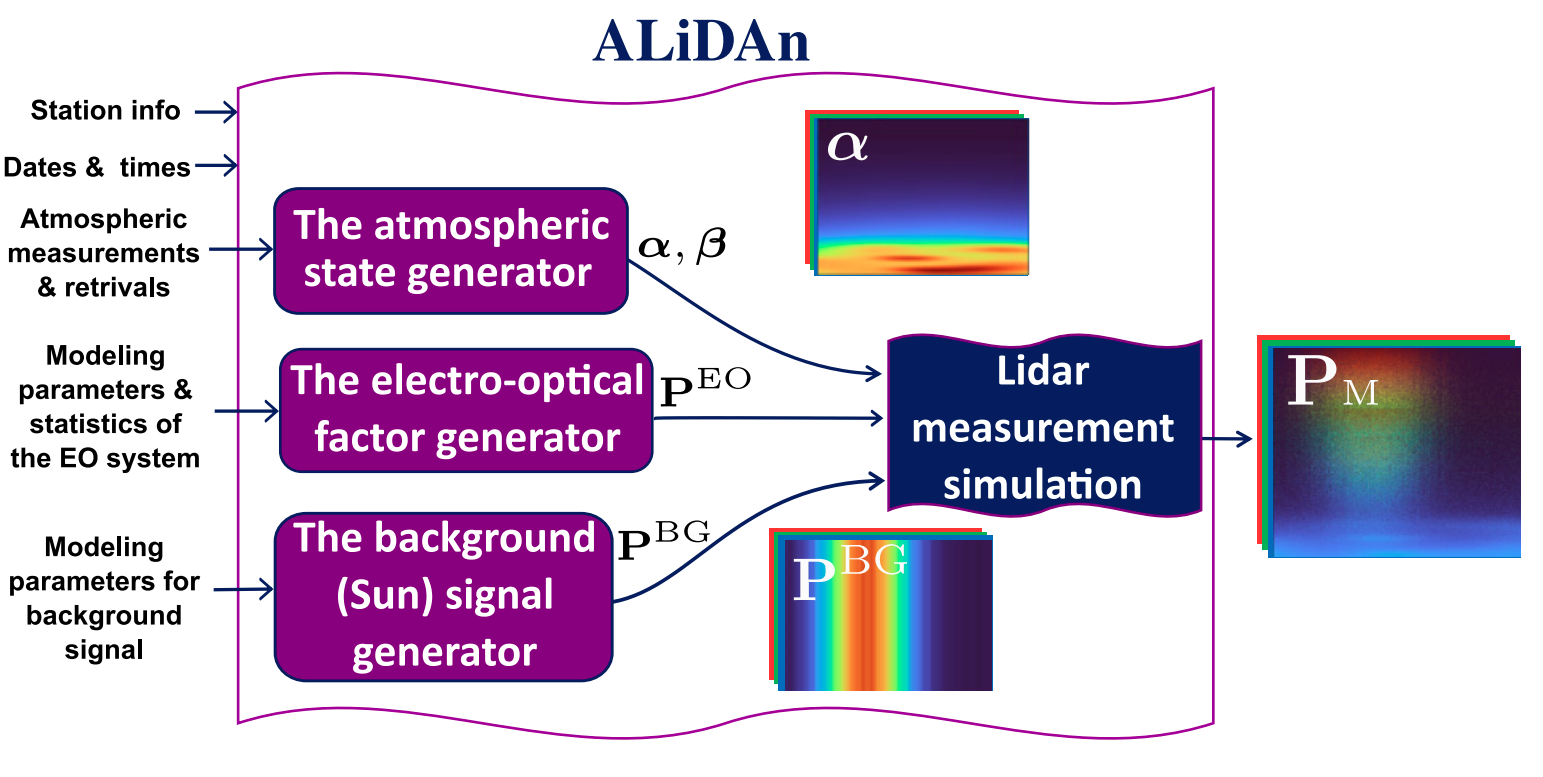
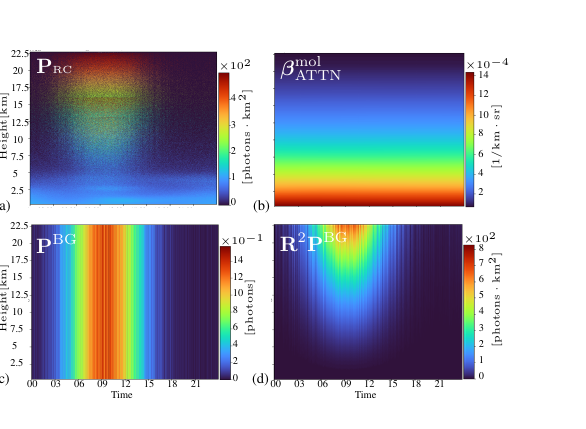
Methods based on statistical learning have become prevalent in various signal processing disciplines and have recently gained traction in atmospheric lidar studies. We propose the Atmospheric Lidar Data Augmentation (ALiDAn) framework to fill this gap.
@article{vainiger2022alidan,
  title={ALiDAn: Spatiotemporal and Multiwavelength Atmospheric Lidar Data Augmentation},
  author={Vainiger, Adi and Shubi, Omer and Schechner, Yoav Y. and Yin, Zhenping and Baars, Holger and Heese, Birgit and Althausen, Dietrich},
  journal={IEEE Transactions on Geoscience and Remote Sensing},
  year={2022},
  doi={10.1109/TGRS.2022.3201436}
}
Calibration of an atmospheric lidar is often required due to variations in the electro-optical system. We present a novel deep-learning (DL) lidar calibration model based on convolutional neural networks (CNN).
@inproceedings{vainiger2022supervised,
  title={Supervised Learning Calibration of an Atmospheric LiDAR},
  author={Vainiger, Adi and Shubi, Omer and Schechner, Yoav Y. and Yin, Zhenping and Baars, Holger and Heese, Birgit and Althausen, Dietrich},
  booktitle={IGARSS 2022 - IEEE International Geoscience and Remote Sensing Symposium},
  year={2022},
  doi={10.1109/IGARSS46834.2022.9883078}
}
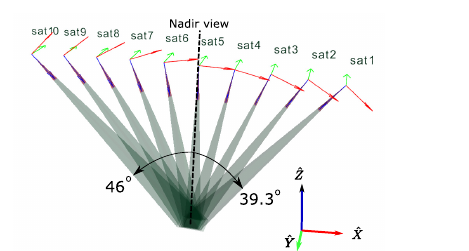
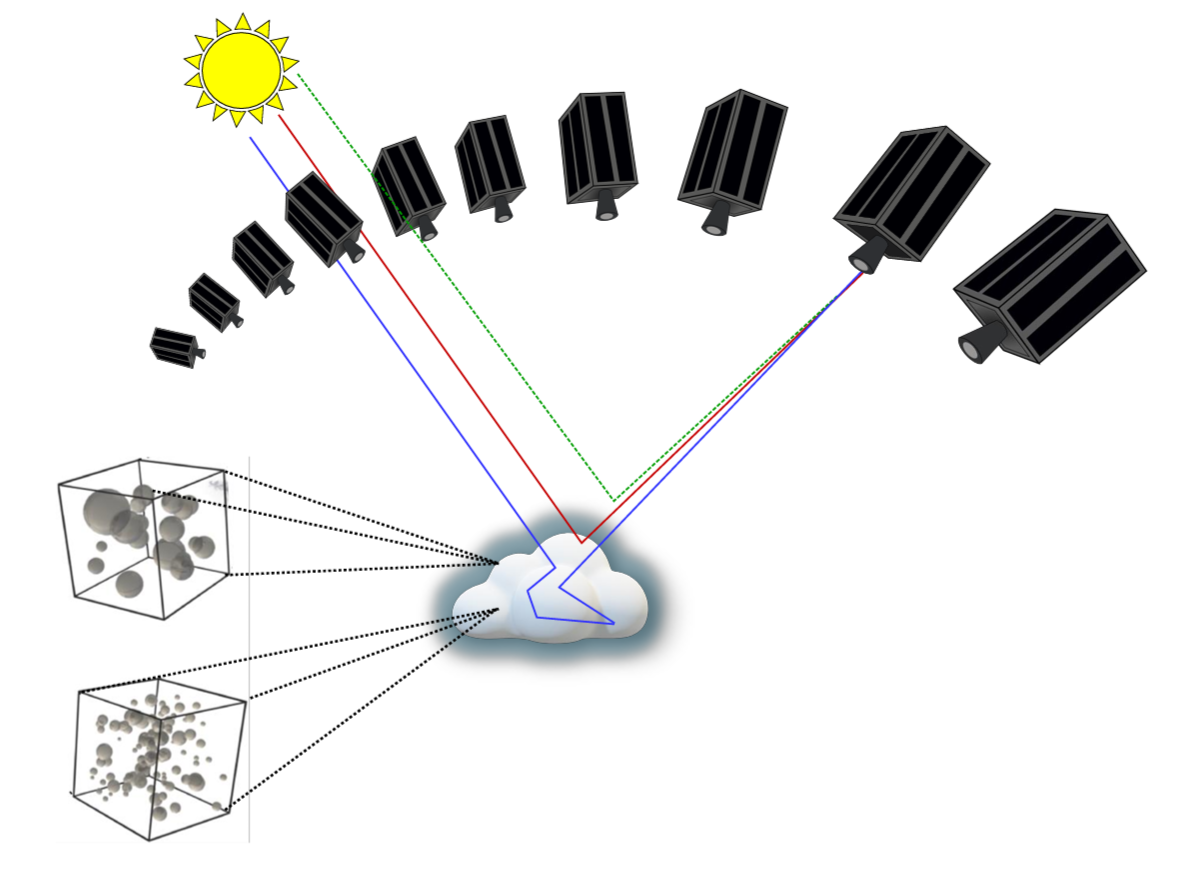
The CloudCT project is a mission that aims to demonstrate 3D volumetric scattering tomography of clouds. A formation of ten nanosatellites will simultaneously image cloud fields from multiple directions, at approximately 20m nadir ground resolution.
@inproceedings{tzabari2021cloudct,
  title={CloudCT 3D Volumetric Tomography: Considerations for Imager Preference, Comparing Visible Light, Short-Wave Infrared, and Polarized Imagers},
  author={Tzabari, Masada and Holodovsky, Vadim and Shubi, Omer and Eytan, Eshkol and Altaratz, Orit and Koren, Ilan and Aumann, Anna and Schilling, Klaus and Schechner, Yoav Y.},
  booktitle={Polarization Science and Remote Sensing X},
  year={2021},
  doi={10.1117/12.2594134}
}
@inproceedings{holodovsky2021cloudct,
  title={CloudCT 3D Volumetric Tomography — Mission Advances},
  author={Tzabari, Masada and Holodovsky, Vadim and Shubi, Omer and Eytan, Eshkol and Altaratz, Orit and Koren, Ilan and Aumann, Anna and Schilling, Klaus and Schechner, Yoav},
  booktitle={EGU General Assembly Conference Abstracts},
  year={2021},
  doi={10.5194/egusphere-egu21-9585}
}
3rd Workshop on Eye Movements and the Assessment of Reading Comprehension · University of Stuttgart
2024 – 2025
Data Science meets Cognitive Science: Decoding Cognitive State during Language Processing
Data Club, Faculty of Data and Decision Sciences · Technion
2024
Non-ordinary Reading as a Frontier for Predictive Modeling and Psycholinguistics
Computational Psycholinguistics Lab, Dept. of Brain and Cognitive Sciences · MIT
2024
Fine-Grained Prediction of Reading Comprehension from Eye Movements
2nd Workshop on Eye Movements and the Assessment of Reading Comprehension, University of Zurich · ISCOL, Haifa · Poster at Highlights in the Language Sciences Conference, Nijmegen, Netherlands
2023
Eye Movements and Neural Traces of Ordinary and Information-Seeking Language Comprehension
Computational Psycholinguistics Lab, Dept. of Brain and Cognitive Sciences · MIT
2023
InvitedEye Movements and Reading Comprehension in Ordinary versus Information-Seeking Reading
Workshop on Predicting Reading Comprehension from Eye Movements · University of Zurich
2023
Eye Movements in Information-Seeking Reading
Short talk · Annual Conference on Human Sentence Processing (HSP) · Virtual
Calcalist (CTech) · 2018 · interviewed as Head of China Business at Watteam
Bio
Education
2023 – Present
PhD Candidate in Data Science, Technion — Israel Institute of Technology
2021 – 2023
MSc (Direct Track to PhD) in Data Science, Technion — Israel Institute of Technology
2017 – 2021
BSc in Data Science and Engineering, Technion — Israel Institute of Technology
Awards
2023 – 2026
Israeli Council for Higher Education (VATAT) Scholarship for Outstanding PhD Students in Data Science
2021
Leonard and Diane Sherman Interdisciplinary Graduate School Fellowship
2021 – 2022
Excellence Dean's Support Scholarship — merit scholarship for Technion alumni
2020 – 2021
Undergraduate President's List — 3 semesters
Research Visits & Training
2024
Brains, Minds and Machines Summer Course, MIT
2024
Visiting Researcher, Digital Linguistics Group, University of ZurichMultiplEYE COST Action Short-Term Scientific Mission
2023
Visiting Researcher, Computational Psycholinguistics Lab, MIT
Industry
2025
Applied Scientist Intern, AmazonSequential Customer Repeated Interaction Prediction using Transformers
2019 – 2021
Research Assistant, Hybrid Imaging Lab, Technion
2015 – 2018
Head of Business Development (China) / Customer Satisfaction Manager / Project & Lab Manager, Watteam
Teaching
2022 – 2026
Head Teaching Assistant, Language, Computation and Cognition
2022 – 2023
Teaching Assistant, Database Management
Service & Volunteering
2024, 2026
Reviewer — ACL, EMNLP, CogSci
2020 – 2027
Undergraduate & Graduate Student Representative for Data Science, Technion Student Association
2022
Mentor, datathon organized by the Technion and Data for Good Israel
Beyond Research
Mountain Biking
I raced cross-country mountain bikes competitively for about ten years and was a two-time Israeli national champion in the youth category. These days I ride purely for fun.